
Like reading, cursive should be taught in a way that is intentional, structured, developmentally appropriate, and connected to how students read and write every day.
The Handwriting Without Tears approach to teaching cursive builds from familiar print skills and introduces cursive through an explicit, carefully sequenced progression that helps students master letter formation, connections, and fluency. We use multisensory activities, guided practice, and clear teacher modeling to support a wide range of learners.
Teaching Cursive with Fidelity
For educators looking for guidance on teaching cursive with fidelity, check out these recommendations:
1. Teach related cursive letters together.
While teaching cursive in alphabetical order may seem logical, it is not the most beneficial sequence. Many effective programs group letters by shared strokes or movement patterns. For example, students might learn letters that begin with similar curves before moving to those with loops, waves, or overcurves. Once they learn a basic movement, they can apply it to related letters.
Educators should follow a consistent letter sequence and common formation language across classrooms. Conflicting verbal cues, starting points, or letter models can make it harder for students to develop automaticity and build upon their skills.
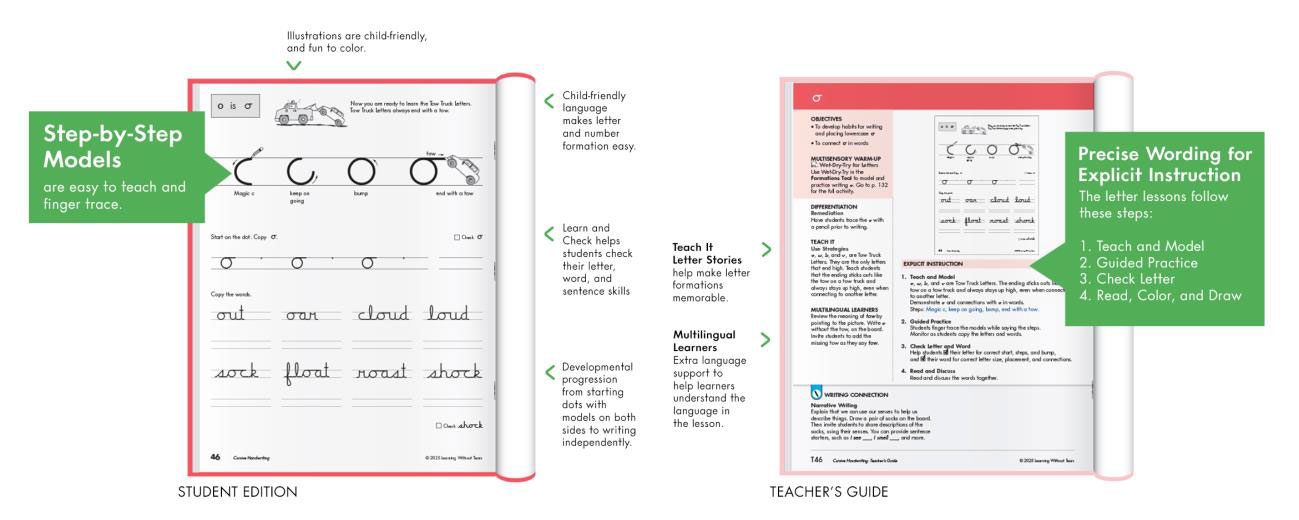
To help teachers introduce cursive letters, Handwriting Without Tears groups lowercase letters with similar formations so students can apply a familiar movement to each new letter. For example, students begin with the Magic C group (c, a, d, and g) before progressing to other related letter groups and connection patterns, including the high-ending Tow Truck letters (o, w, b, and v).
- Teacher’s Guides reinforce this sequence with common, child-friendly formation language, step-by-step models, explicit teaching scripts, guided practice, and opportunities for students to check their work.
- Student editions, letter-group posters, formation charts, and digital animations use the same models and cues, helping teachers provide consistent instruction across classrooms.
2. Model every movement explicitly.
Explicit instruction is an essential step in learning cursive. When teachers model letter formation and connections while providing concise verbal prompts, students can observe and understand the movement patterns they will later use in their own practice. Teachers can demonstrate the following:
- Where the letter begins
- Which direction the pencil moves
- How the stroke relates to the writing line
- Where the letter ends
- How a letter connects to the next letter
Handwriting Without Tears supports explicit cursive instruction by giving educators clear, consistent language and step-by-step models for demonstrating each letter.
- Teacher’s Guides provide precise wording that helps teachers explain where a letter begins, how the pencil moves, and how each stroke is formed.
- Student Editions reinforce the same formation sequence through illustrated directions and guided practice.
- Classroom formation charts and digital demonstrations show students the correct stroke order, letter placement, and movement needed to form and connect cursive letters.
3. Include short, frequent practice sessions.
Handwriting is a motor skill, and distributed practice is more effective than infrequent marathon sessions. The Institute of Education Sciences advises using multiple short handwriting sessions and moving beyond isolated letter practice to authentic writing.
For many schools, it may be realistic to dedicate 10 minutes of focused instruction and practice on most days during the initial learning phase. The exact schedule should reflect grade-level needs and state requirements, but consistency matters more than creating an occasional 30- or 40-minute handwriting block.
Handwriting Without Tears makes consistent handwriting practice manageable within the school day. Lessons typically take just 10–15 minutes, allowing educators to provide frequent instruction and review without creating a separate handwriting block. Teacher’s Guides and the Interactive Digital Teaching Tool (IDTT) help teachers plan and deliver brief lessons consistently, while built-in Writing Connections, Reading Connections, and customizable activities extend practice beyond isolated cursive letters.
4. Gradually move from forming letters to meaningful writing.
Students need ample practice with cursive letters and connections before they are asked to complete classroom assignments in cursive. Asking students to write in cursive before they have developed a solid understanding of letter formation patterns and connections can increase cognitive load, making it difficult to determine whether a student is struggling with organization, spelling, composition, or handwriting.
A sound cursive scope and sequence progresses through these stages:
- Foundational strokes
- Lowercase letter formation
- Lowercase letter connections
- Words and sentences using learned letters
- Capital cursive letters
- Authentic written responses
Handwriting Without Tears supports this gradual progression by establishing cursive mechanics before expecting students to use cursive in written work. Beginning with Cursive Kickoff in Grade 2, students review familiar print formations, practice foundational cursive movements, and begin learning letters through explicit, multisensory instruction. From Grade 2 through Grade 6, cursive instruction builds progressively from letter formation and connections to reading and writing words, sentences, and authentic written responses while supporting the development of legibility, speed, and fluency.
5. Incorporate multisensory practice purposefully.
Teachers can guide students in practicing cursive stroke sequences through air writing, finger tracing, and textured surfaces. These multisensory activities help make pencil-and-paper practice more effective by allowing students to develop movement patterns with large-motor actions before refining them with small-motor movements. Multisensory instruction is most effective when activities reinforce the same starting point, stroke sequence, and verbal language students use when writing on paper.
Handwriting Without Tears uses purposeful multisensory activities to reinforce explicit cursive instruction and pencil-and-paper practice. Using Wet-Dry-Try on the blackboard with Double Lines, students can trace a teacher-modeled letter with a small wet sponge, repeat the movement with a paper towel, and then form the letter independently with chalk. During multisensory activities, teachers use the same concise, step-by-step formation language students will hear during handwriting instruction and student edition practice.
6. Apply cursive in authentic contexts.
Authentic applications help students understand that cursive writing is a communication tool rather than a separate exercise. They also give teachers a more accurate view of whether students can maintain legibility outside a controlled practice page. Once students have received explicit instruction and guided practice, schools can incorporate cursive into:
- Names and signatures
- Spelling and vocabulary practice
- Short journal entries
- Thank-you notes
- Science observations
- Responses to historical documents
- Select portions of writing assignments
Handwriting Without Tears helps students apply cursive by connecting handwriting instruction to meaningful literacy and content-area activities. Teacher’s Guides include activities that extend cursive practice into spelling, vocabulary, reading, writing, and classroom content, helping students use cursive for authentic communication.
Measuring Cursive Progress and Proficiency to Support Students’ Growth
Effective cursive assessment should be brief, instructionally meaningful, and provide clear recommendations that help educators support continued student progress. When selecting or designing an assessment, consider the skills it should measure:
Districts should establish common cursive expectations and collect only enough data to guide instruction and document progress. Unless state policy says otherwise, classroom work samples, short performance tasks, teacher-administered screeners, and instructional rubrics can provide meaningful information about students' progress without creating an excessive assessment burden.
Learning Without Tears’ Screener of Handwriting Proficiency takes the guesswork out of cursive assessment planning. After administering the 10–15-minute assessment and entering students’ scores online, teachers receive immediate individual and class-level results highlighting students’ strengths and areas for growth.
Screener insights make it easy to choose targeted next steps using resources in the IDTT, including digital formation tools, animations, videos, printables, customizable worksheets, and digital practice. Together, these resources support an assess-teach-monitor cycle that helps teachers meet students where they are and provide focused instruction based on identified needs.
Developing a Realistic Cursive Implementation Plan
Districts preparing for a new or revised cursive mandate this school year can organize implementation around seven actions.
Complete a policy crosswalk.
Identify the state and district requirements that will shape implementation, including grade levels, required skills, assessment expectations, accommodations, reporting requirements, and timelines.
Define your instructional goals.
Translate requirements into student outcomes. For example, “teach cursive” is not a curriculum target. Instead, “Write a legible three-sentence response using correctly formed and connected cursive letters by the end of Grade 4” is measurable.
Establish a districtwide scope and sequence.
Select a consistent cursive style, group letters using shared movements, and map instruction across the required grades.
Protect instructional time.
Establish a consistent time and place for cursive instruction within the school day.
Prepare your teachers.
Successful cursive implementation depends on well-prepared teachers. Professional learning helps ensure consistency and effective instruction.
Monitor progress before proficiency is required.
Monitor student progress throughout the year to identify students who may need additional modeling, guided practice, or intervention.
Communicate expectations with families.
Provide families with your cursive alphabet model, formation language, and guidance for supportive home practice.
Choosing Cursive Curriculum Resources
A cursive curriculum should make cursive easy to teach and apply. It should not add more work to a literacy block. When evaluating cursive instructional resources, use these criteria:
- Is the scope and sequence developmentally appropriate?
- The program should follow a developmentally appropriate sequence that begins with foundational strokes and groups letters by shared movement patterns and connections. As students learn new letters and connections, they should apply their skills through carefully sequenced practice with words and sentences.
- Does it provide explicit teacher guidance?
- Resources should show teachers how to model each letter and connection, provide instructional language to use, anticipate common errors, and include support strategies for students who need additional practice.
- Can it fit into the existing literacy block?
- Look for flexible pacing and short lesson structures.
- Does it include meaningful assessment?
- Progress-monitoring tools or assessments should measure the outcomes listed in your state's requirements, including letter formation, spacing, alignment, legibility, reading, and application.
- Does it support diverse learners?
- Your cursive program should include modifications for left-handed writers, students with fine-motor challenges, multilingual learners, students receiving special education services, and students who need additional practice or alternative response modes.
- Does it support consistency across grades?
- Shared models, language, and scoring criteria help districts build a coherent program rather than a collection of disconnected classroom practices.
- Does it connect cursive to real writing?
- The strongest resources should create a bridge from handwriting lessons to spelling, vocabulary, sentence writing, and composition. While students must practice handwriting first, the handwriting itself should not be the ultimate instructional goal.
Changes in policy or curriculum may be the reason your district is relooking at how it approaches cursive instruction, but compliance should not be your only measure of success. The goal is to give students an efficient, legible means of written communication.
Confidently Teach Cursive Using Handwriting Without Tears
Handwriting Without Tears builds confident writers through the use of consistent language and resources spanning across grade levels. With a coherent curriculum, realistic pacing, print and digital educator resources, and progress monitoring tools, school and district leaders can meet cursive requirements while building writing skills that serve all students.
Discover how Handwriting Without Tears provides explicit, developmentally appropriate cursive instruction that fits into today’s classrooms.