
Screening data should go beyond identifying individual skill gaps. It should help teachers determine the next steps for support.
The Learning Without Tears Screener of Handwriting Proficiency provides two levels of reporting to help educators make well-rounded, informed instructional decisions.
1. Class Reports
Class reports show performance across memory, orientation, placement, and sentence skills. They compare results with a Tier 1 achievement target in which at least 80% of students are expected to meet or exceed benchmark expectations.
If more than 20% of students in a classroom do not meet expectations in a specific handwriting skill, the data shows that the teacher may need to reteach that skill to the whole class. For example, consider a class in which most students can remember the correct letters and orient them correctly, but more than 20% struggle with placement.
These results give teachers something much more actionable than a general handwriting score. It suggests that the teacher should reevaluate classroom instruction around baseline placement. Strategies and activities for teaching proper letter placement skills are included in the “Remediation Options” drop down under the score.
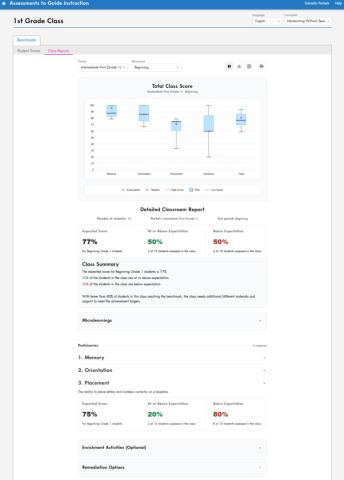
This data shows that 50% of students are meeting overall expectations, but only 20% are meeting expectations with placement skills. Expand the “Remediation Options” for targeted teaching strategies.
2. Individual Reports
Individual reports show how a student’s current printing or cursive writing skills compare with benchmark expectations. The report also shows gains in those skills made throughout the year and identifies areas where instruction or intervention should focus. If a student performs below proficiency in an area, teachers can use the provided remediation suggestions to plan instructional next steps.
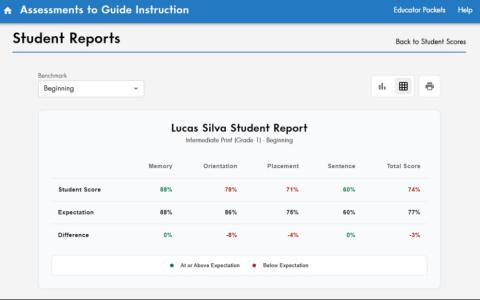
This student is meeting expectations in Memory and Sentence skills, but Orientation and Placement skills are slightly below expectation.
Why Screen Students Throughout the Year?
Progress monitoring answers an essential question that a single handwriting evaluation cannot: Is what we are doing helping students improve? Completing an assessment once provides a snapshot of students’ handwriting skills at that point in time. It does not capture each student’s full story. Completing progress monitoring screenings throughout the school year shows whether a student is improving and if instruction and interventions are working.
The Screener of Handwriting Proficiency is designed to be administered three times during the school year at consistent intervals. This allows teachers to identify needs, adjust instruction, and then see whether those changes are producing results. The cycle becomes: Screen. Review. Instruct.
This cycle is especially important when a student or class is not meeting expectations. If whole-class results fall below the Tier 1 target, teachers can implement targeted classroom instruction and continue screening to see whether class performance improves. If an individual student remains below expectation and most of the class is progressing, teachers can build out additional small groups or individual intervention.
The Screener of Handwriting Instruction can also help teachers observe broader skills gaps in letter formation, baseline placement, consistency of style, size, fluency and speed, posture, and pencil grip.
Using the Screener: From Reports to Recommended Action
Handwriting Without Tears includes the Screener of Handwriting Proficiency within the Interactive Digital Teaching Tool (IDTT), making it easy for teachers to access within the instructional environment they already use to teach print and cursive. More importantly, identified areas of need can point educators toward relevant Handwriting Without Tears instructional and remediation resources within the IDTT, creating a tighter assessment-to-instruction cycle.
A teacher who discovers that her class is having issues with placement does not have to leave the reporting environment, search through unrelated resources, and determine what intervention might address the skill. The assessment has already identified the skill, and the IDTT provides resources that can help students build it.
Maximizing Your Instructional Time
Teachers already observe student writing, provide instruction, score work, and interpret results. The Screener of Handwriting Proficiency gives educators a more accessible, structured way to identify needs at both the individual and class level so that instruction can have the greatest impact. For those working in states that have adopted cursive writing requirements, these insights can also help demonstrate that students are meeting expectations for proficiency.
The Screener of Handwriting Proficiency helps educators turn results into action. By reviewing data at the individual and class levels, teachers can focus on instruction, providing targeted support, and monitoring progress throughout the year.
Not a current Handwriting Without Tears user? Access the lite version of the Screener of Handwriting Proficiency on our Resources page.