
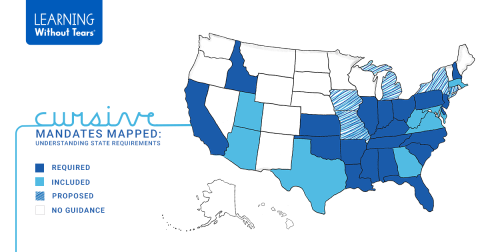
As a new school year begins, district leaders must stay informed about evolving education legislation and state standards that may impact their schools and classrooms. Cursive handwriting is now a policy in more than half of U.S. states. State legislatures and boards of education are increasingly mandating cursive writing instruction in classrooms, recognizing its critical role in literacy development. Some states require that students reach proficiency by a certain grade level, whereas others outline how cursive should be taught and assessed. Understanding these trends can help inform curriculum planning, professional learning priorities, and classroom implementation, whether their state has already adopted cursive requirements or is considering them.
What Does a “Cursive Mandate” Mean?
Cursive mandates are state laws or sets of educational guidelines that require districts to follow policies related to teaching cursive. Some states have statutes requiring public schools to provide direct cursive instruction. These statutes often specify the grades for instruction, define skills students should master, or require districts to report compliance. Other states address cursive through their own academic standards, model curricula, or instructional frameworks rather than a cursive-specific statute. Here are a few ways cursive has appeared across the country:
- Texas incorporates cursive expectations into its state standards, Texas Essential Knowledge and Skills, with cursive instruction beginning in second grade.
- Ohio law directs its state education agency to include handwriting guidance and supplemental materials in its K–5 model curriculum. The state leaves decisions about the use of model-curriculum materials to local school boards.
- New Hampshire lawmakers require public school districts and charter schools to provide cursive writing instruction by the end of fifth grade. The requirement treats cursive as part of English language arts (ELA) but does not require students to pass a specific test or reach a particular proficiency score.
Other states have no clearly identified statewide cursive requirements. Districts and schools in those states may still be required to teach cursive, but the decision can be made at the local level.
Five Trends in Recent Cursive Mandates
Many states give local districts some leeway in choosing how they’ll teach cursive and what materials they’ll use. Understanding the direction of state policy can help districts make better curriculum decisions, even as laws and requirements evolve.
1. Most requirements focus on instruction in the elementary grades.
Most states are focusing formal cursive mandates on students in grades 3–5. This allows students to develop foundational handwriting skills in the primary grades before they are expected to form connected cursive letters. This supports research that shows students need to learn handwriting in a coherent progression that spans multiple grades.
2. Most states are moving from cursive exposure to cursive proficiency.
Some earlier requirements asked teachers to provide a unit of cursive instruction. More recent policies define what students should achieve by the end of fifth grade. These skills include:
- Forming uppercase and lowercase cursive letters correctly
- Connecting letters within words
- Using appropriate size, spacing, and alignment
- Writing words and sentences legibly
- Reading cursive text
- Applying cursive in authentic assignments
3. Cursive is being added into literacy instruction.
Most cursive mandates don’t require handwriting as a separate subject. Instead, lawmakers place cursive instruction within an ELA framework, supporting research that shows students need explicit instruction to form and connect cursive letters. Once students learn this, they can apply cursive in literacy activities. For example, Maryland’s College and Career Ready Standards Framework for ELA and Literacy address cursive formation and application beginning in second grade, reflecting this broader trend of integrating practice within their larger learning plans.
4. State leaders are paying more attention to student accommodations.
Cursive mandates should consider students with fine-motor differences, dysgraphia, physical disabilities, or learning differences. New Hampshire law allows teachers to provide accommodations or waivers through Individualized Education Programs or Section 504 plans. New Jersey’s guidance advises adjusting instruction or expectations, providing assistive technology, and consulting occupational therapists when appropriate. The goal is equitable participation and meaningful skill development.
5. Legislation often leaves major instructional decisions up to districts.
Even detailed state statutes rarely prescribe a complete handwriting curriculum. District leaders still need to determine:
- Which cursive style students will use
- How much time in the ELA block will be allocated specifically to cursive
- How teachers will sequence letters in instruction
- Which resources teachers will use
- How proficiency will be measured
- How accommodations and interventions will be implemented
Mandates in Your State for the 2026–27 School Year
Several states have passed laws related to cursive instruction policy that go into effect this school year.
New Jersey
New Jersey’s Department of Education has directed public schools to incorporate cursive handwriting instruction into grades 3–5 beginning with the 2026–27 school year. The state’s guidance calls for curriculum and instructional materials that help students become proficient in reading and writing cursive by the end of fifth grade. It also recommends explicit, systematic, developmentally sequenced instruction covering letter formation, connections, spacing, and fluency. The law outlines consistency among grade levels, guided practice, authentic application, assessment, assistive technology, and accommodations for students with disabilities.
Florida
Florida’s most recent cursive legislation requires cursive instruction for public school students in grades 3–5, effective July 1, 2026. By the end of fifth grade, students should be able to form uppercase and lowercase cursive letters, write legible words and sentences with appropriate spacing and positioning, and read cursive.
Pennsylvania
Pennsylvania passed Act 2 in February 2026, adding printing, joined italics, and cursive handwriting to the writing curriculum in elementary public and private schools. Unlike Florida’s law, Pennsylvania’s provision does not prescribe a specific grade or individual proficiency test, giving schools more flexibility over pacing and implementation.
Turning Cursive Mandates into Effective Instruction
As cursive mandates evolve, it’s evident that state lawmakers and education leaders continue to recognize the value of teaching cursive. Mandates are now becoming increasingly focused on making cursive instruction more consistent and accessible to every student. State requirements may differ in terms of grade levels taught, proficiency expectations, and local flexibility, yet all recognize the role handwriting fluency plays in developing reading and writing skills.
By choosing a cursive curriculum with a clear instructional sequence, teacher support materials, and student accommodations, school and district leaders can more easily integrate cursive instruction into their literacy programs.
Ready to build a consistent, developmentally appropriate cursive program that meets your state mandate? Explore Handwriting Without Tears to discover structured handwriting instruction, teacher support, and resources designed to help every student develop fluent, confident writing skills.