
State and district leaders have invested heavily in Science of Reading instruction and are starting to see reading gains. Yet, even as students improve their reading proficiency, they are still struggling to write clear, complete sentences.
In a recent edWeb webinar, Sentence Writing: The Overlooked Element of the Science of Reading, Dr. Cheryl Lundy Swift, director of Professional Learning and Academic Partnerships at Learning Without Tears, and Dr. Shawn Datchuk, professor of Special Education at the University of Iowa, explained why sentence writing continues to be the missing link in science of reading literacy initiatives—and how educators can meaningfully incorporate sentence writing practice into their instruction.
LWT Poll 1: How proficient are your students at writing strong sentences?
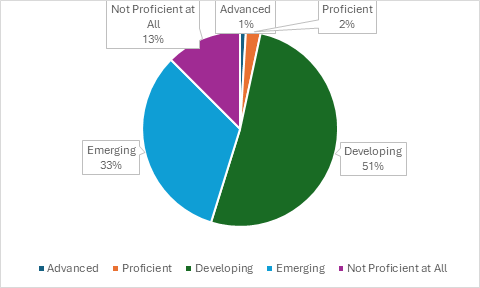
Reading and Writing: Partners, Not Competitors
Many educators think that if they devote more time to writing, they are stealing time away from reading instruction, but Datchuk said the research does not support that mindset.
“Even though we can think about these as separate, we really can't separate reading from writing,” he said. “They develop together, they support each other, and they thrive when they're taught in connection.”
Reading and writing draw upon several of the same skills, including phonological awareness, decoding, spelling, syntax, vocabulary, and language comprehension. When students receive combined, high-quality reading and writing instruction, their achievement improves in both areas, he said. Writing (especially note-taking and written responses) has a measurable positive effect on reading comprehension, and there’s a strong relationship between word reading, spelling, and sentence construction. By strengthening students’ writing skills, educators can build upon their existing Science of Reading efforts.
The Synergistic Relationship Between Reading and Writing
Understanding how reading and writing develop together begins with recognizing the strong alignment between two foundational frameworks: The Active View of Reading and The Simple View of Writing. Both are parallel processes that draw upon overlapping cognitive and linguistic skills. Understanding what those skills are and how they overlap can help educators design stronger literacy systems.
The Active View of Reading, proposed by researchers Nell Duke and Kelly Cartwright (2021), argues that reading comprehension cannot be explained by decoding and language comprehension alone (e.g., the Simple View of Reading). To be successful, readers must draw upon additional processes to actively build meaning from texts. Students must use executive functioning skills—particularly attention, working memory, and cognitive flexibility—to become successful readers.
Active View of Reading
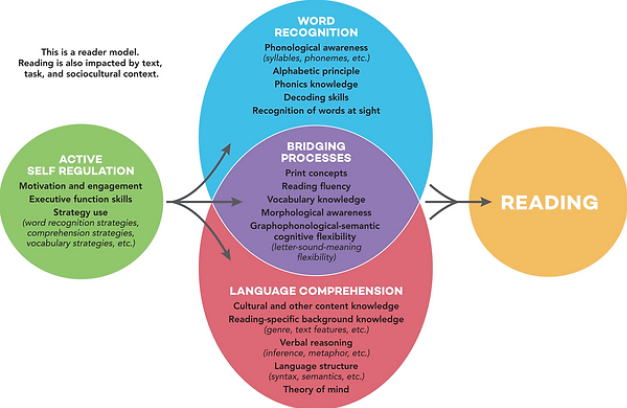 [Source: Duke, N. K., & Cartwright, K. B. (2021). The science of reading progresses: Communicating advances beyond the Simple View of Reading. Reading Research Quarterly, 56(S1), S25-S44. https://ila.onlinelibrary.wiley.com/doi/full/10.1002/rrq.411]
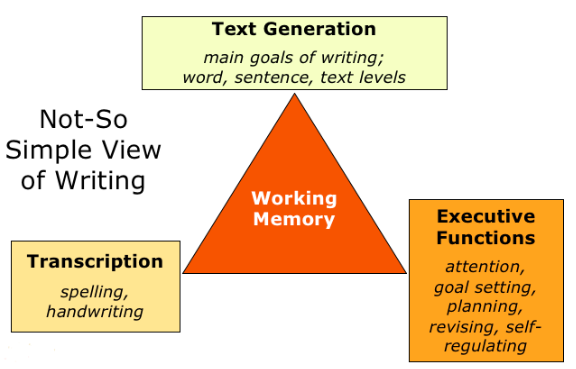
 The Simple View of Writing, developed by Berninger and colleagues, explains that writing is made up of three interconnected components: transcription, text generation, and executive function.
- Transcription includes the physical skills of writing—handwriting, spelling, and keyboarding.
- Text generation involves turning ideas into sentences and paragraphs using vocabulary, syntax, and background knowledge.
- Executive function help writers plan, organize, monitor, and revise their work.
Because all three components draw on students’ limited working memory, challenges in handwriting, spelling, or sentence construction can make it difficult for students to focus on higher-level writing skills such as organization.
Simple View of Reading
“When students read or write, it's rarely a straight line from start to finish. They pause, they think, reflect. What do I know? What am I actually trying to say? These thinking and managing processes—planning, goal setting and self-monitoring, even revising—are all happening at once,” she said. “Students are juggling multiple mental tasks, like holding ideas and working memory, while actually writing them down. And just like with adults, we can't do everything perfectly all at the same time, which is why these skills need to be practiced enough to stick into our long-term memories.”
Sentence Writing Skills Don’t Grow by Accident
Students express their ideas through sentences, not just through words or phrases. When a student cannot reliably construct a complete thought with a logical structure using appropriate vocabulary and correct punctuation and syntax, they cannot produce strong paragraphs or essays.
Just like reading, writing requires explicit instruction. However, in most classrooms:
- Writing instruction is minimal
- When students do get the opportunity to practice writing, it’s often worksheet driven.
- There is little teacher modeling of how sentences should be constructed.
- Students get too little practice actually constructing sentences, and not enough teacher feedback.
Because of this lack of structured instruction around sentence writing, students don’t naturally develop strong sentence skills. Teachers shouldn’t view sentence-writing as an “add-on.” Explicit sentence-writing instruction takes between 10-15 minutes of instruction and can fit into any ELA core curriculum.
“Sentence writing doesn't grow by accident,” Lundy Swift said. “It grows when two things are in place: explicit instruction and fluency practice. If we want better writers, we must commit to these two cornerstones. Teaching writing explicitly and having students practice writing regularly, that's the foundation for strong sentence writers and that's what it's built on.”
Five Tools for Building Strong Sentence Writers
Educators are looking for ways to help students who struggle to write even the simplest sentences. It’s teachable, it’s manageable, and there is a clear formula that works, Datchuk said. By breaking sentence writing into predictable steps, modeling the process, and building fluency through short, structured routines, teachers can help every student grow into a confident, capable sentence writer.
LWT Poll 2: How confident are you at teaching students to write strong sentences?
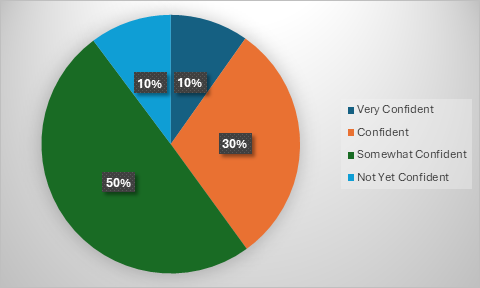
Datchuk and Lundy Swift described five tools that have been used successfully to improve sentence writing. The first three involve careful design of the lesson, while the last two provide strategies for teaching the lesson.
1. Segment Sentence Writing into Smaller Units
Instead of teaching sentence writing in a single step, Datchuk recommended three instructional formats educators can use to gradually build complexity:
- Identify – Ask students to identify parts in written sentences (e.g., underline capital letters, circle verbs, find the “part that names” someone or something).
- Complete – Have students fill in missing elements in partially written sentences.
- Generate – Ask students to write full sentences using picture–word prompts.
By carefully sequencing these formats, teachers can control difficulty and build confidence without overwhelming students, he said.
2. Prepare Instructional Scripts
Rather than starting with dense grammatical terminology, Datchuk suggested educators provide a simple, child-friendly definition of a complete simple sentence. For example:
Name someone or something and tell more.”
He acknowledged that identifying elements of a sentence, such as parts of speech, can be taught later, warning against asking struggling writers to identify subjects, predicates, linking verbs, and gerunds.
Using streamlined language reduces initial complexity and allows students to gain working control of complete sentences more quickly, he said.
3. Select Strategies for Active Student Responses
Students should be talking a lot during writing instruction, not just writing silently. For example, educators can use vocal responses to:
- Leverage students’ oral language strengths.
- Allow for quick feedback before students commit to text.
Teachers can also use:
- One-on-one questioning.
- Unison responding (everyone responds after think time and a signal) when answers will be similar.
- Individual share-outs when students generate different sentences.
Eliciting student responses builds fluency and keeps all students engaged—not just the few called on to share their writing at the end, he said.
4. Use a Model–Lead–Test Framework
Educators can take the following approach typically used in an explicit instruction sequence:
- Model (I do) – The teacher demonstrates and thinks aloud.
- Lead (We do) – The teacher and students practice together, orally and in writing.
- Test (You do) – Students practice more independently while the teacher monitors and supports.
Educators do not have to follow this sequence rigidly. If students struggle during guided practice, it’s appropriate to return to modeling, Datchuk said.
5. Structured Fluency Routine
Once students understand the basic building blocks of a sentence, they need repeated, timed practice to make those skills automatic.
Datchuk described eight-step fluency routine educators can use with picture–word prompts, including:
- Review prior Correct Writing Sequences (CWC) scores and set goals to increase student scores. CWC is a method that looks at every pair of words for correct spelling (or phonetic plausibility), capitalization, punctuation, grammar, and meaning.
- Give ten picture-word prompts to students.(Datchuk suggests giving students more picture prompts than they can finish in the time allotted.)
- Review prompts with students and answer any questions.
- Set a time limitof one to two minutes to get students to write about pictures in short bursts.
- Once students begin writing, start the timer.
- At the end of the time limit, collect the writing of at least one student.
- Provide “live” performance feedback in the form of a CWS score. By scoring one student sample “live” in front of the class, teachers can help students understand how to earn points for more precise, detailed, and well-structured sentences.
- Praise specific parts of the students’ writing in front of the class; for example, “You included a noun and a verb.”
- Provide any error correction to the sentence you’re reviewing.
- Repeat steps 1–6 for a total of three timings.
- Collect timed practice writing from students and have students graph the highest score of the day.
“Through these routines, students begin to understand how actually the sentences grow and how they get more points, which motivates them to stretch beyond ‘The dog ran’ and toward big, juicy sentences,” Lundy Swift said.
Supporting Emergent Bilingual Students
Emergent bilingual learners particularly benefit from using picture prompts and oral language in sentence-writing instruction.
“One of the great things about using a picture word prompt or series is that emergent bilinguals are able to identify something that strikes a chord with their background knowledge,” Datchuk said.
Educators should also include vocal responses so students can rehearse ideas orally before they begin writing. To help students warm up, they can also front-load a small set of key vocabulary words students can intentionally weave into sentences.
From Research to Ready-to-Use Tools: Building Writers: Cornerstones™
Advancing literacy means closing the gap between what students can read and what they’re able to write. Direct sentence writing instruction provides the cornerstone to written communication, deeper comprehension, and academic success.
As research and countless classroom experiences confirm, explicit and systematic instruction gives students the tools to craft clear, correct sentences. The result: stronger writers, more confident readers, and classrooms where every student has a voice.
In response, Learning Without Tears designed Building Writers: Cornerstones to guide teachers and students through the sentence-writing process. The program bridges the divide between writing individual words and constructing paragraphs, focusing first on sentence mastery. Cornerstones addresses oral language and written words in kindergarten, before advancing to complete and correct sentence writing in Grades 1 and 2. By the end of Grade 3, students learn to write complete, cohesive paragraphs. The program takes a step-by-step approach to ensure students develop each prerequisite skill before progressing onto more complex writing.
Cornerstones Program Highlights and Benefits
- Foundational Skills Focus: Lessons specifically target the sentence writing and paragraph construction skills that most core ELA curricula overlook.
- Concise, High-Impact Lessons: 10–15-minute sessions fit flexibly into any ELA schedule, providing the focused, repeated practice that is often missing from traditional writing blocks.
- A Research-Aligned Structure: The program is developed from research, including the work of Datchuk and Learning Without Tears curriculum design teams, ensuring every strategy and routine is evidence-based.
- Active, Multisensory Writing Instruction: Hands-on activities, engaging teacher resources, and independent practice are all part of the program.
Discover how Building Writers: Cornerstones can bridge the critical gap between writing words and composing paragraphs. See how this research-aligned program systematically develops sentence-writing fluency and fits seamlessly into your current literacy work. Download a sampler.